
The Newcastle Edge: What Makes This Region Australia’s Economic Outlier
XCap’s focus on the Newcastle and Hunter Region is grounded in a straightforward mentality: invest where demand is supported by multiple economic drivers, not a single cycle.
As Managing Director, Geoff Robinson has spent years assessing regional markets across Australia through that lens. His starting point is consistent. Before looking at performance, he tests whether a region has the fundamentals that sustain activity through different conditions.
“We apply the same checklist every time,” Geoff says. “Infrastructure, employment depth, education, defence and tourism. Very few regions have all of those drivers operating together.”
In his assessment, the Newcastle and Hunter Region is one of the few that does.
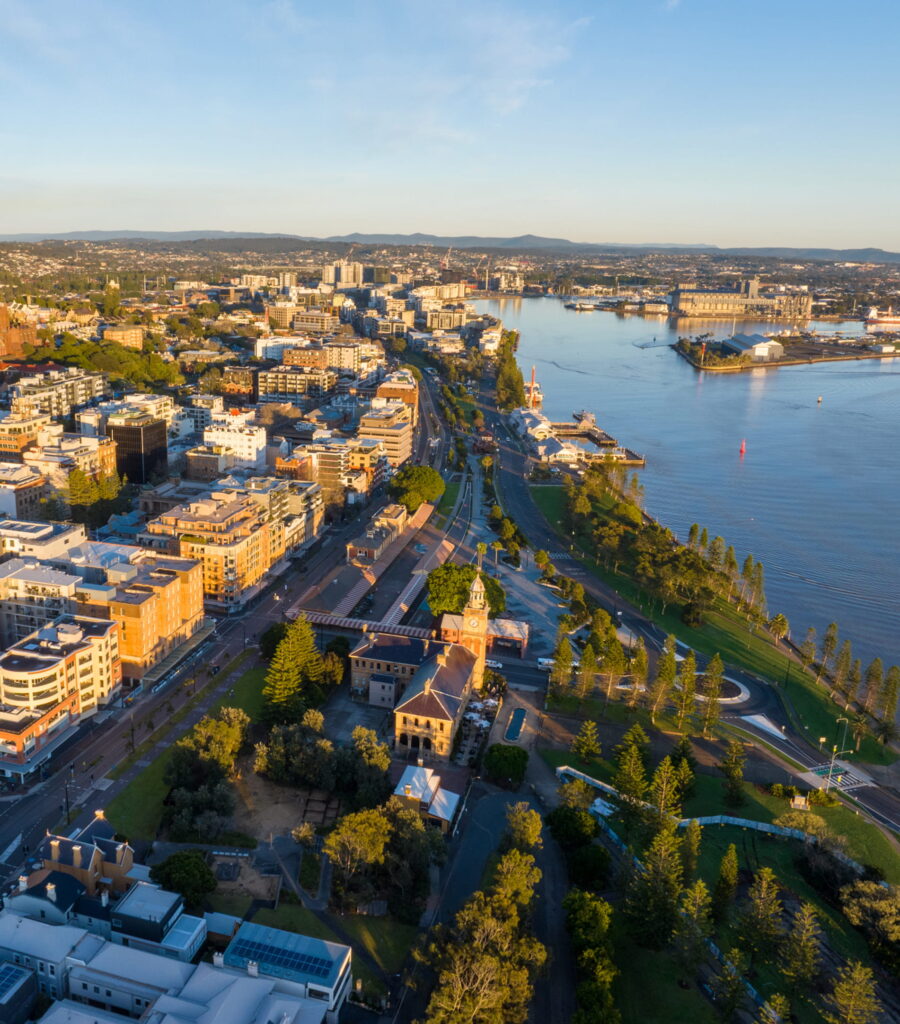
Newcastle, NSW
Infrastructure and Economic Scale
The Newcastle and Hunter Region’s economic strength is reflected in the scale of its output. The region is now Australia’s largest regional economy, with Gross Regional Product of $96 billion, ranking ahead of the ACT, Tasmania and the Northern Territory.
In FY23/24, the region’s Gross Regional Product (GRP) grew 6.8%, outperforming all states and territories. For context, NSW grew 1.2%, Victoria 1.5%, Queensland 2.1%, Western Australia 0.5% and South Australia 1.2%. The ACT recorded 4.0%, the Northern Territory 4.6% and Tasmania 1.4%.
For Geoff, that performance reflects infrastructure depth rather than cyclical momentum.
“Road, rail, airport and port. If those ingredients are there, the rest of the economy has something to build from,” he says.
In the Hunter Region, that network is both operational and expanding:
- Port of Newcastle, the largest port on Australia’s east coast, and the world’s largest coal export port supporting large-scale trade and industrial activity.
- Newcastle Airport, with international terminal upgrades complete and international flights active as of late 2025, it is a major regional gateway.
- Integrated road and rail corridors linking the region directly to Sydney and the eastern seaboard.
This level of connectivity enables multiple sectors to operate concurrently. It reduces reliance on a single growth driver and supports economic activity at scale.
Employment Depth and Essential Services
Scale alone does not create resilience. The composition of employment beneath that scale determines how consistently an economy can perform.
The Hunter Region supports more than 273,000 jobs across a diversified base of sectors, reducing reliance on any single industry cycle. Key anchors include:
- Health: John Hunter Hospital, the largest regional hospital in NSW, reinforcing the region as a major health services centre and employment hub.
- Education: The University of Newcastle, contributing workforce development, research capability and long-term participation in the regional economy.
- Defence: RAAF Base Williamtown, NSW’s largest air force base, providing stable federal investment and supporting a broader ecosystem of contractors and professional services.
- Tourism: Newcastle’s coastline and the Hunter Valley, attracting more than 11 million visitors annually and generating significant expenditure across retail and hospitality.
These sectors sit alongside other important contributors across agriculture, mining, government services, manufacturing and construction, further reinforcing the Hunter Region’s economic breadth and supporting long-term regional growth.
“What differentiates the Hunter Region is not one dominant industry,” Geoff says.
“It’s the convergence of essential services, defence, education and infrastructure within the same economy. When those sectors are operating together at scale, demand becomes more durable and less exposed to short-term cycles, it has all of the key ingredients ticked”
This breadth of employment, spanning essential services and industry, creates a more balanced and predictable demand profile than many regional markets can offer.
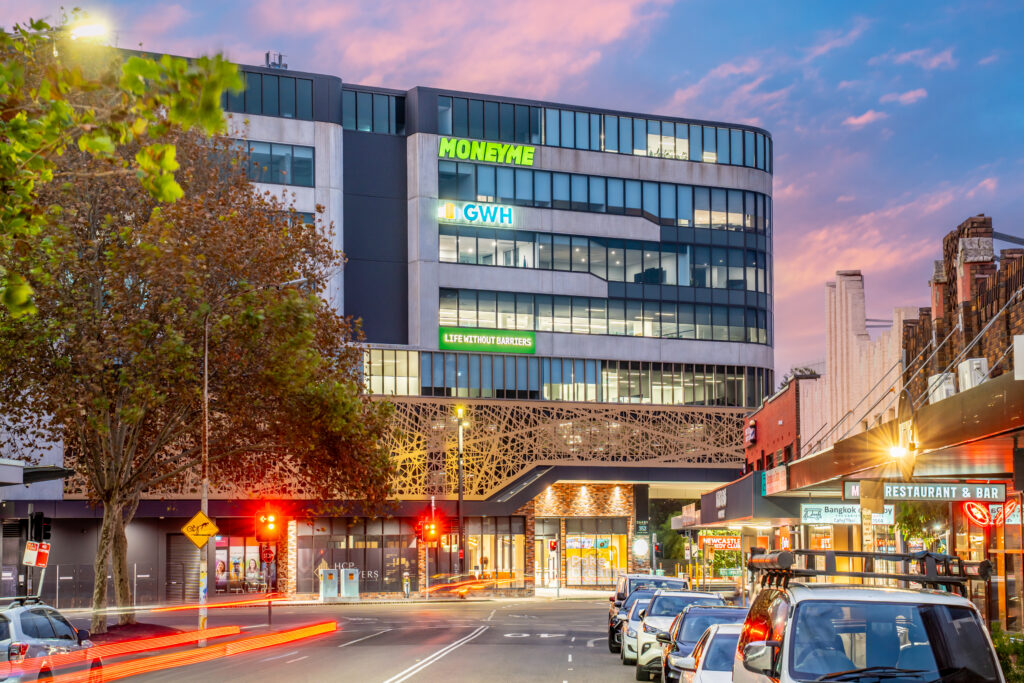
Darby Plaza, Newcastle
Population Growth and Market Signals
Alongside employment depth, another key market Geoff looks for is whether population is rising in a way that expands the region’s underlying demand base. In the Hunter Region, population is forecast to grow by 12.1% over the next decade, adding further scale to an economy already operating at regional centre level.
That growth increases the number of households, workers and businesses participating in the region’s economy. It broadens the demand profile across housing, retail, logistics and commercial space, and supports additional service capacity within established centres.
Recent market behaviour reflects that expansion. Residential activity continues to respond to household formation and inward migration. Industrial precincts linked to freight and distribution corridors remain active as supply chains adapt and trade activity evolves. Commercial centres continue to function as the administrative and professional backbone of the region, rather than as speculative growth nodes.
For Geoff, the significance lies in how that growth integrates with what is already in place.
“When population growth is building on top of established infrastructure and employment, it reinforces the system,” he says. “You’re adding depth to a market that is already operating.”
In the Hunter Region, projected growth is being absorbed by connected centres and service corridors that already support economic activity. That alignment between scale and expansion strengthens the investment landscape and provides clearer visibility around where demand is likely to concentrate over time.
The XCap Perspective
XCap’s conviction in Newcastle and the Hunter Region is grounded in long-term local experience, built through GWH’s more than 30 years of delivery across the area and a detailed understanding of how its corridors function in practice. That history provides a clear understanding of its location fundamentals, tenant demand and how the market evolves over time, and it continues to shape where we invest.
This approach is reflected in the XCap LFR Heatherbrae Fund, positioned along one of the region’s primary movement corridors serving everyday demand, and in the XCap Core Plus Income Fund, anchored in established commercial centres in Newcastle CBD and Charlestown.
“Across Australia, there are only a handful of non-metro markets that operate at genuine economic scale. Newcastle and the Hunter Region stand above the rest, and that depth gives us confidence in how assets will perform over time,” concluded Geoff.